Parián de los Japones: An Overview
A film by Sheila Lina
austen’s emma in 1601 Manila with Samurai
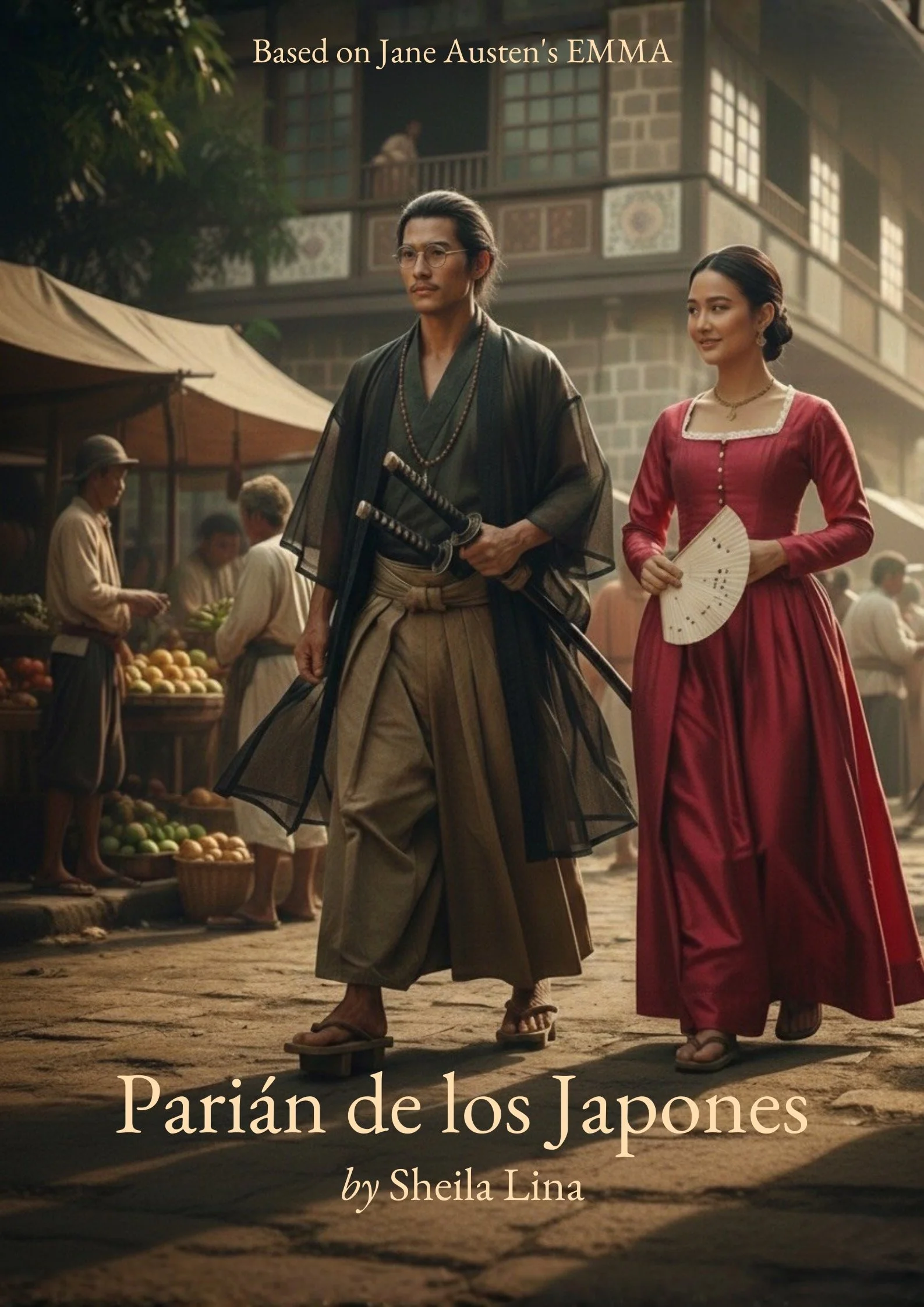
thanks nano banana.
working on 2 versions. a proof of concept short film and a full length feature/limited series
Short Logline: In 1601 Manila, a privileged mestiza who prides herself on reading people engineers a match between her Japanese refugee ward and a charming Spanish official — only to discover she misread his intentions, costing her the closest thing she has to a sister.
Feature Logline: In 1601 Manila's Japanese enclave, a privileged mestiza matchmaker has spent years loving her estate manager without ever naming it — until the threat of losing him forces her to finally recognize what he has always been to her.
Why Emma in 1601 Manila
Emma has been adapted across centuries and cultures, most famously as Clueless, Amy Heckerling's 1995 comedy set in Beverly Hills, a film so complete on its own terms that countless viewers have loved it for decades without ever realizing it was Jane Austen. The story travels because it earns it: the romance is swoony, the moral heart is sound, and the structure is sturdy enough to carry any social world you place it in.
And 1601 Manila gives that structure somewhere extraordinary to go. Japanese Christian exiles, Spanish colonial elite, and Tagalog nobility converging in one port city at the birth of global trade — every collision produces meaning unavailable anywhere else. That proven structure and singular setting allow this film to say complex things economically and elegantly — about postcolonial identity, the paradoxes of privilege, and agape versus transactional love — without having to build the argument from scratch. The audience arrives trusting the story. The setting gives those ideas somewhere specific, grounded, and irreplaceable to land.
The Proof-of-Concept Short Film
Maria Emilia "Mia" Mendiola is 21, brilliant, kind, and self-assured. She welcomes Yuki, a Japanese orphan refugee into her home — the closest thing she's had to a sister. When Diego Velasco, a Spanish official of genuine decency, shows extraordinary attention to Yuki, Mia engineers a match between them with well-intentioned confidence, never suspecting that every kindness Diego extends to Yuki is meant to win her own heart. When Diego finally declares himself, Mia's certainty crumbles and takes Yuki's trust with it. The reconciliation, when it comes, is tender and sincere. Mia a little wiser, a little more careful — but still Mia.
Why This Story
Emma endures because it wittily embodies a piercing truth in character: discernment has moral stakes. It’s about a privileged young woman whose greatest strength, the ability to read people, becomes dangerous the moment she trusts her own judgment absolutely.
This adaptation asks: what if Emma’s blind spot operated in a world where being wrong about people had sharper consequences?
Highbury sees Emma navigate a genteel Regency hierarchy. 1601 Manila sees Mia navigate Spanish colonial bureaucracy, Samurai martial code, Principalia land wealth, and Japanese Christian exile simultaneously.
Mia’s fractured identity lets her read across these worlds with razor precision. This strength becomes a devastating flaw when tainted by hubris.
For Yuki, a Japanese orphan refugee, Mia’s presumption and overreach are not just social missteps. Yuki’s precarity is material.
For Mia, who has no mother, sister, or female mentor, Yuki isn’t just a matchmaking project, she’s the closest thing to a sister, and a vital link to a way of being Japanese that Mia has never fully lived as a woman.
For Diego, a Spanish official, pursuing a mestiza is made permissible only by Mia’s charm and wealth. His presumption of Mia’s affections escalates to mortal danger.
Unlike Austen’s Mr. Elton, whose obsequious self-importance remains socially contained, Diego is not a villain — he is Mia’s mirror.
Both are well-intentioned, intelligent, generous, and charming. Both see their virtues devolve when corrupted: his by colonial entitlement, hers by hubris. The goodness and the flaw become inseparable and weaponized to hurt.
Their strengths do not soften their flaws; they produce them. It is precisely because they are often right, and genuinely good, that they fail to see when they are actually wrong.
This blindness produces their romantic misperception in parallel but asymmetric ways:
Diego projects his inherited, ambient, and unexamined colonial worldview on Mia. He assumes she understands the rules of this world and misreads her warmth, which is Mia’s strategy to encourage his affection for Yuki, as reciprocated romantic interest. What he fails to see is that Mia is ascribing to him a higher moral frequency of goodness. He is unaware how cruel his words and assumptions might sound. He interprets Mia’s protestations as coy propriety.
Mia is aware of colonial prejudice yet accustomed to rare exceptions, like Padre Julian. She overconfidently misreads Diego’s extraordinary care for Yuki and his moral conviction as signs of transcendence of such systemic biases and evidence of his romantic interest in Yuki.
Layered on top of this blindness is a second identical flaw in structure: the very care that defines them produces expectation of reward. Mia’s sisterly devotion to Yuki makes her feel justified in determining Yuki’s future; Diego’s assiduous efforts make him feel entitled to Mia’s intimacy. Both act on misperception and cause harm.
It takes the collision of their respective flaws for both to realize the truth: Diego wants Mia. Mia wanted Diego for Yuki. And love that still has the ego attached isn’t truly love.
In the end, what is required is not perfection, but humility. The courage to ask for forgiveness, and the grace to extend it. Healing and growth, though never guaranteed, remain possible.
Such intricate flaws—rooted in virtue, intelligence, and care—are not excised like ordinary ones; they endure as long as the strengths that power them remain.
What changes is the awareness of them, and the care with which one moves through the world.
Only in the aftermath of the collision does Mia learn to trust fully, surrendering sole reliance on her own understanding, and anchoring that trust where it truly belongs.
This arc, how Mia is blind to her own flaws, is the short film’s territory. The feature explores what comes next: how she is blind to her own love.
The Vision and the Title: Parián de Los Japones
While Philippine-Japanese cinema has long been defined by the shadows of WWII, and Spanish-colonial films by the late 19th-century revolution, Parián de Los Japones ventures into an untouched cinematic frontier. It illuminates the 17th-century convergence of the Samurai and the Galleon Trade—a vibrant era of synergy and tension that has remained largely absent from global cinema.
Dilao is the name of the separate quarter that the Spanish used to contain the increasingly challenging community of Japanese settlers. Parián is the name specifically for the Chinese quarter. However, historically, the name Parián de los Japones was also used by the Spanish interchangeably to refer to the Japanese community.
It is my deliberate choice as a Filipino artist to use this name as a larger statement on the fluid nature of community and identity. Who gets to define who you are, how you are called, what role do you get to play?
The word Parián is derived from the Cebuano and Tagalog word parián, meaning a market or trading place. This etymology is the heart of the film: our heroine begins as a creature of the marketplace, understanding all relationships as exchanges. Affection for influence, companionship for security, love negotiated like silk and silver. The film follows her exodus from this parián economy of transaction into the impossible mathematics of Agape, where love is given freely without expectation of return. Set within a community born from transactional necessity, the film is a visceral exploration of unconditional love in its filial, platonic, romantic, and spiritual forms.
Visual palette and Cinematic Influences
Tropical Spanish colonial architecture and lush Philippine landscapes meet the precision of Japanese minimalist aesthetics. Sofia Coppola's painterly impressionism layered over Wong Kar-Wai's restrained yearning.
Sonic Landscape
A masterful mix of period appropriate language and song juxtaposed with modern iconic pop.
Dialogue will be historically accurate Japanese, Spanish, and Tagalog.
Music
Score: Minimal, atmospheric, strings + atmospheric electronics. Aspirational Original score by Rosalía
Diegetic: Period appropriate Tagalog/Japanese/Spanish Music
Special exception for Harana arrangements of
Unique Salonga’s Sino from Grandma
juan karlos’ Buwan
Non-Diegetic:
Björk’s All is Full of Love from Homogenic
Olivia Rodrigo’s brutal from Sour
Cardi B’s Drip (feat. Migos) from Invasion of Privacy
Rosalía’s Nos Quedamos Solitos from Los Ángeles
Niño de Elche’s El Tango de la Menegilda from Antología del Cante Flamenco Heterodoxo
Joji’s Die for You from Smithereens
Lorde’s 400 Lux from Pure Heroine
The Characters:
MARIA EMILIA “MIA” MENDIOLA: The Matchmaker/Emma Woodhouse
JŌJI NAKAJIMA: The Ronin Estate Manager / Mr. Knightley
MASATO MENDIOLA: The Samurai Father/Mr. Woodhouse
PADRE JULIAN DE MENDOZA The Priest /Dionne from Clueless adaptation
BEATRIZ SANTOS The Formidable Businesswoman /Mr. Hall (from Clueless adaptation, Gender-Flipped)
CHEN WEI: The Gentle Romantic / Miss Geist (from Clueless adaptation, Gender-Flipped)
RAFAEL HIDALGO: The Childhood Friend /Frank Churchill-Jane Fairfax, Gender-Flipped
ISABEL DE MENDOZA: The Goddess /Frank Churchill-Jane Fairfax, Gender Flipped
YUKI: The Orphan/ Harriet Smith
DIEGO VELASCO: THE Alguacil/ Mr. Elton

manifesting my dream cast. Kentaro Sakaguchi, Takeshi Kaneshiro, Javier Bardem, Dolly de Leon, Tony Leung, Manny Jacinto, Rosalía, Guillermo Lasheras
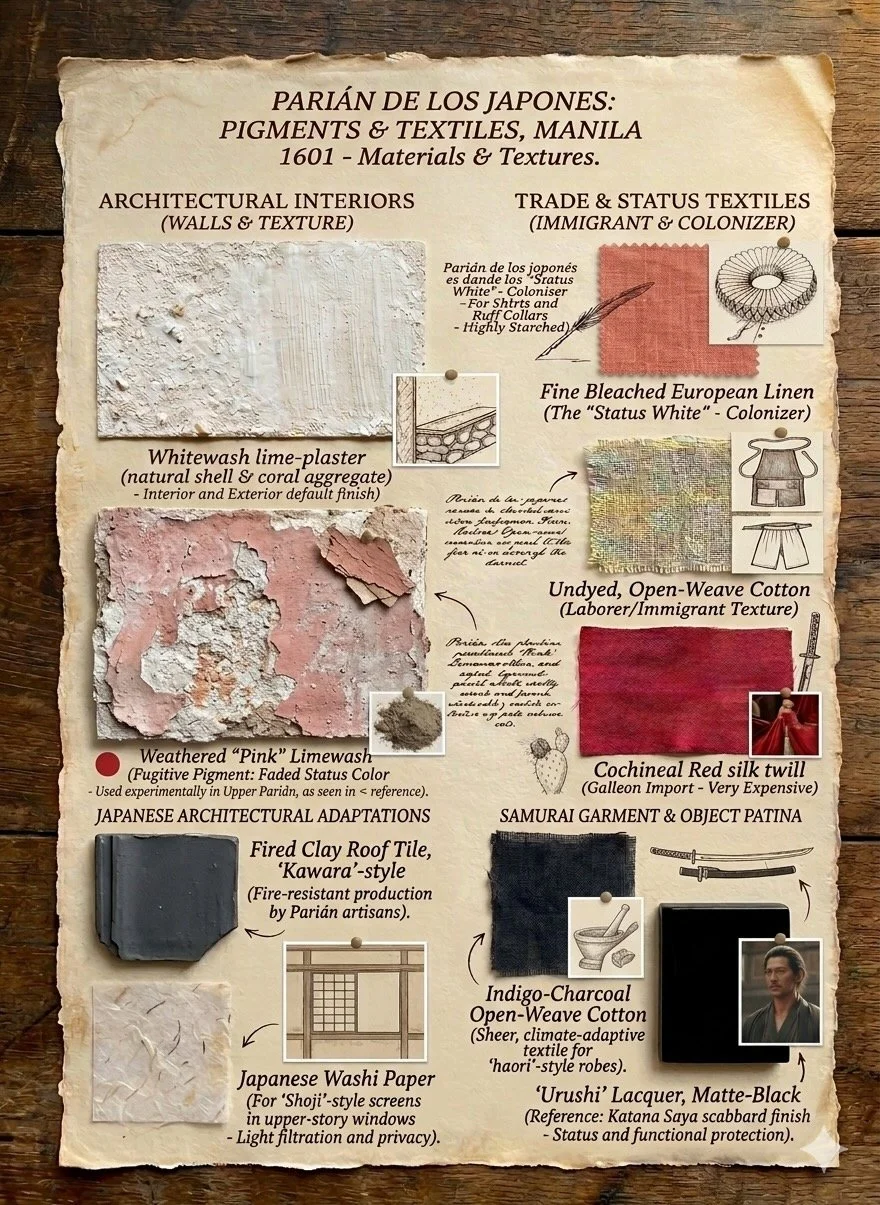
The Proof-of-Concept Short
The 25-minute proof-of-concept short is a standalone work and the foundation for the feature pitch. The short is built to feature standard. With dialogue in Japanese, Spanish, and Tagalog, a Claire Mathon-level cinematographer, and period-appropriate production across all departments.
Primary target: Cannes Critics' Week 2027 (February 2027 deadline).
The Filmmaker
Sheila Lina is a first-time writer-director with a musical theater acting background. This short exists specifically to answer the question: can she execute a multilingual period drama at Cannes-caliber standards while carrying the lead role?
The proof-of-concept is designed to make that question answerable with 25 minutes of evidence rather than promises. If the short delivers, the feature pitch comes with proof. If it doesn't, investors learn that before committing feature-scale capital.
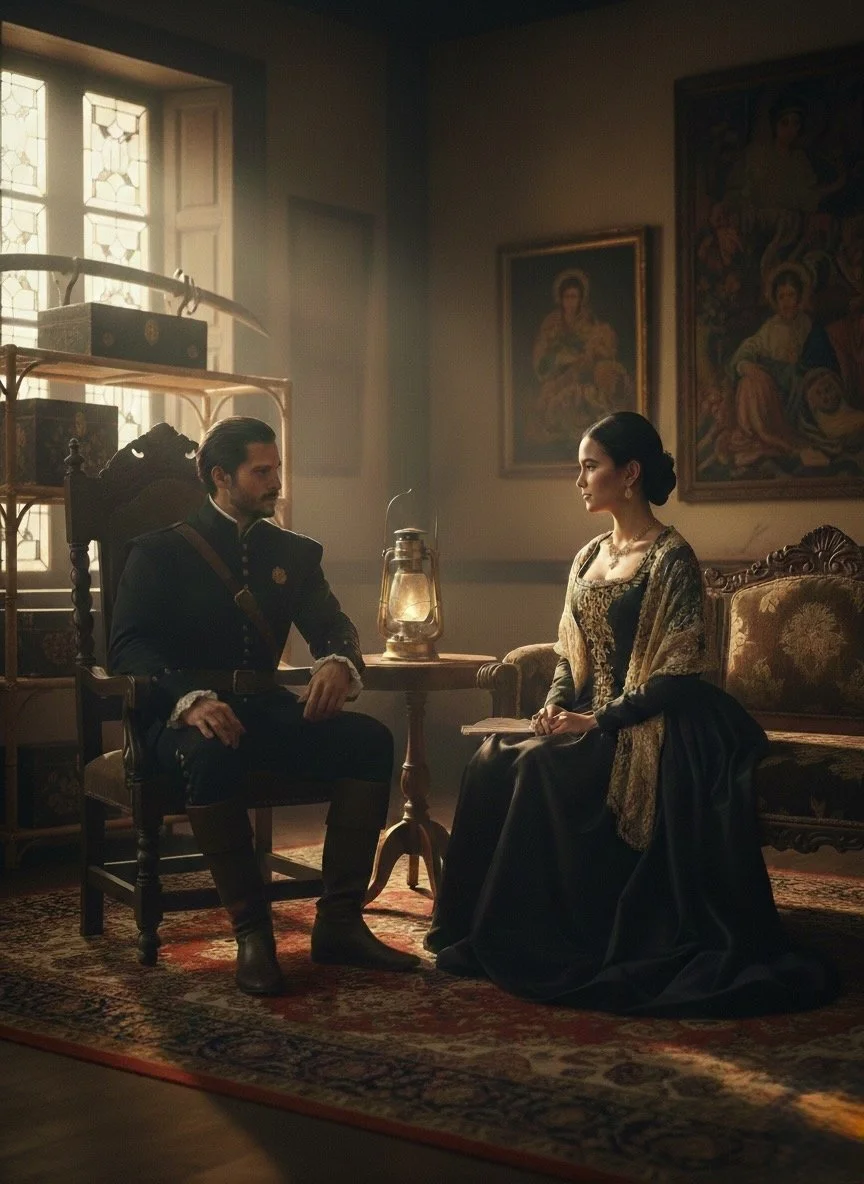
Diego and Mia before the truth comes out